1. What Is Campus Recruitment?
For major companies, recruitment generally follows two tracks: campus recruitment and social recruitment. The biggest difference lies in the target group: campus recruitment targets new graduates, while social recruitment targets experienced professionals. Consequently, the focus of evaluation also differs.
Social recruitment emphasizes technical ability more, because social positions often arise from urgent project needs and teams short on people, requiring someone who can “plug and play.” Campus recruits, on the other hand, universally lack practical experience; interviewers treat them as blank slates, so campus recruitment focuses more on assessing “potential.”
So where is potential reflected? The most important screening tool is academic background.
In China, the gaokao is the fairest, most standardized, and officially endorsed selection mechanism. In a sense it represents a person’s execution ability, learning ability, and stability within a long-term education system. Companies filter by academic background essentially to lower recruitment costs—technical skills can be trained, but academic credentials cannot be retroactively improved.
2. Main Factors Influencing Campus Recruitment
For technical positions, it comes down to nothing more than luck, academic background, internships, and projects. Let’s set luck aside. Academic background broadly divides into 985/211 and non-985/211 (shuangfei). Many companies/departments still filter for Double First-Class universities (as far as the internet sector goes). If I were to rank these four factors, my answer is: luck > academic background >> internships > projects
Some may argue, shouldn’t the value of a major-company internship outweigh academic background? Maybe during the internship phase you can land many offers, but internships and campus recruitment are completely different. Internship work generally involves miscellaneous tasks, and an intern can stay at most around six months. Campus recruits are different—for the interviewer, the first-round interviewer is your future colleague, hiring a comrade-in-arms to work alongside; for the second-round interviewer, they are hiring a soldier who will charge forward in the future. Academic background may not represent everything, but it at least represents that during your three years of high school you flawlessly executed the tasks your teachers assigned and delivered a perfect answer on the gaokao. So a major-company internship can only to a certain extent narrow the gap between you and 985/211 graduates. More often, your competitors are other non-985/211 graduates.
I’ve seen a second-tier university graduate with one major-company internship land offers from Alibaba Taotian (filters by academic background), Meituan, and Tencent. I’ve also seen a non-985/211 graduate with three major-company internships come away empty-handed during autumn recruitment. And I’ve even seen a 985 graduate with one small-company internship breeze through autumn recruitment. But this does not mean your efforts are meaningless. I believe no path is truly wasted.
3. Trends in Campus Recruitment
In terms of front-end and back-end roles, the market shifts rapidly, but the overall trend is downward. Last year, the 2025 batch of front-end campus recruitment was still decent. In just one year, front-end for the 2026 batch has started to collapse across the board. Based on this year, I’ve summarized several noticeable changes:
3.1 The Rapid Development of AI
2025 can be called the year AI boomed the fastest, even the year of the Agent. All sorts of new concepts and technologies keep emerging. Although in previous years people kept shouting “front-end is dead,” only this year has a genuine sense of crisis hit me. Will the development of AI make front-end disappear? The answer is no. PHP from over a decade ago still has people writing it. However, demand for front-end will inevitably shrink. Front-end headcounts at small and medium companies will further decrease, and even some small companies may eliminate the front-end role entirely. Major-company demand may stagnate in the short term, but the impact won’t be too big. Still, I think when a big company’s business growth stagnates, that itself is a step backward.
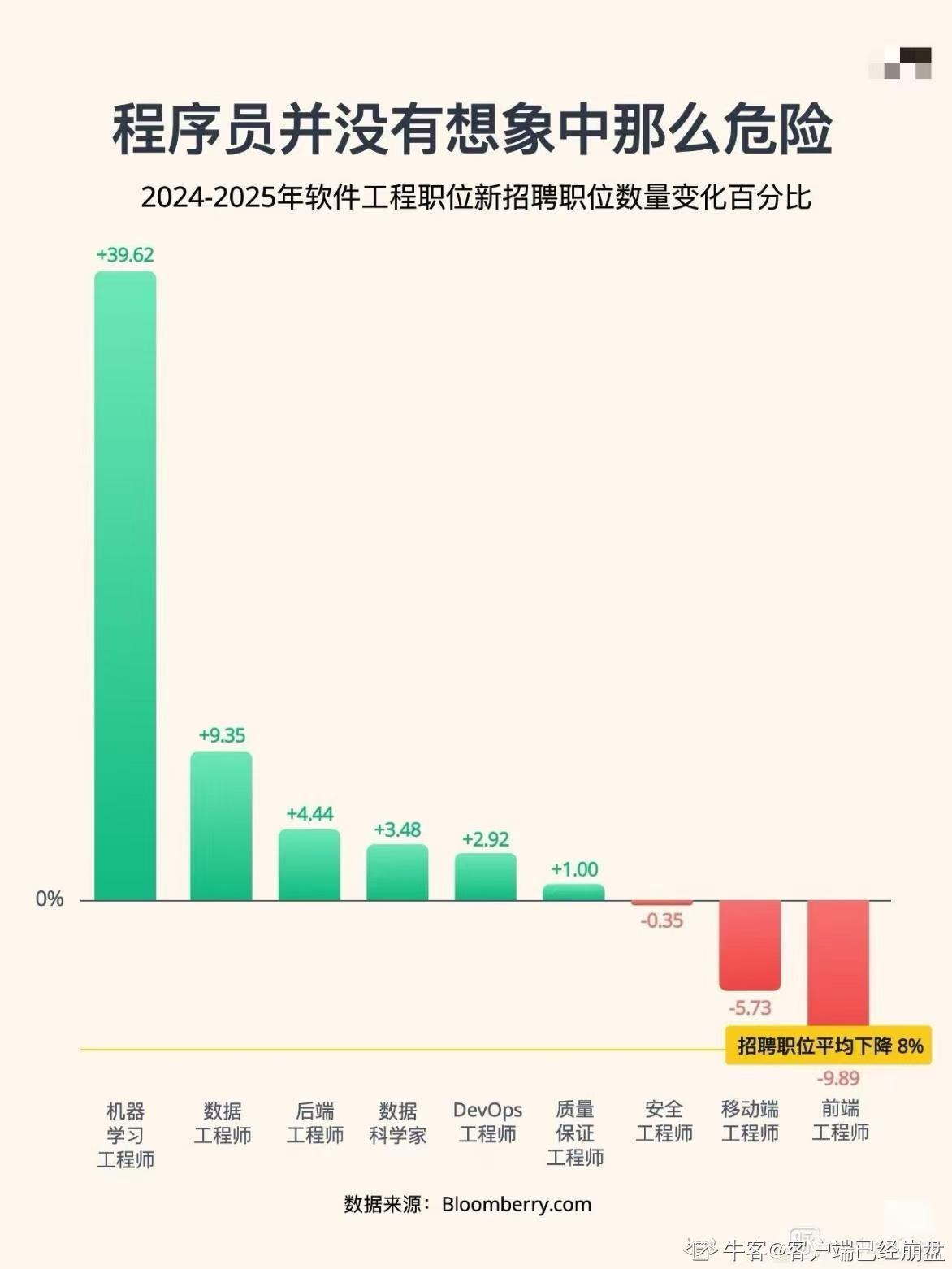
圖1
3.2 The Devaluation of Major-Company Internships
It seems starting from the 2024 or 2025 batch, I’ve noticeably sensed an increase in major-company internship positions on the market, especially at ByteDance and Meituan. Routine internships are essentially recruiting all year round. Looking at friends around me this year, having 2–3 major-company internships is no longer rare. As the saying goes, when something is abundant it loses value—when everyone has a major-company internship, those internships become devalued and lose their luster. I’ve asked several juniors from the 2027 batch, and almost all had two internships by the second semester of their sophomore year. The wave of internship competition will only intensify, and companies are happy to see this. On the one hand, intern compensation is negligible compared to full-time employees, even lower than outsourcing. On the other hand, the quality of fresh graduates keeps improving, giving companies access to higher-caliber graduate resources. It’s all benefit and no harm for the companies, you could say.
3.3 High-Academic-Qualification Market Downward Shift
When people hear “double nine” (bachelor’s and master’s both from 985 universities), the first thought is usually research or algorithms. But judging from this year’s situation, many double-nine master’s graduates are choosing front-end roles. This is actually a market-descending phenomenon: from double-nine master’s grads doing algorithms, to doing back-end, and finally even front-end. I find this terrifying, and it further confirms that the internet market is saturating.
Speaking of high academic qualifications, one must mention that especially famous credential-focused company—BYD. Before 2022, a “single two” (bachelor’s from 211 or above) would basically get an offer just by applying. By 2024, “double two” (bachelor’s and master’s both 211 or above) would get an offer just by applying. This year, “double nine” (bachelor’s and master’s both 985) gets an offer just by applying.
This is the real environment of the internet industry today: the pool is shrinking, but more and more water is pouring in.
4. Planning and Choices
A grain of sand from the times, when it falls on an ordinary person, becomes a mountain. Since you cannot change the environment, you can only change yourself. Change brings life; stagnation means death.
The speed of change in the internet is something traditional industries cannot match. In campus recruitment, planning and choices grow ever more important. A decade ago maybe you could goof off for three years and then crunch for one final year to land a decent company, but today that won’t work. If your goal is to enter a medium-to-large enterprise, you must plan early and put in the effort.
4.1 The Information Gap
Computer science is never a pursuit done behind closed doors. Besides upgrading your technical skills, you also need to gather new “information.” If your school is 985/211 or has very strong employment outcomes, your seniors may have already blazed a trail for you. But if your school is not great and there is no established path, you can only cross the river by feeling the stones, forging your own path—and the “information gap” is the key to forging that path.
For instance, if I want to pursue front-end or back-end development, what tech stacks do I need to learn? If I want to land an internship at a big company, how should I craft my resume? Where should I submit my resume? When should I submit it? These all have techniques, and they are part of computer science.
As a freshman just entering university, how can I bridge the information gap? First look within your school: are there notable labs or studios? Do those studios have alumni still working at major companies? If not, then turn your attention outward. I recommend using Niuke (Nowcoder), the gathering place for computer science campus recruits. Many people exchange experiences on Niuke, and you can also join some chat groups. Of course, this information is messy, so you need to have your own filtering and judgment.
4.2 Execution and Drive
Computer science is a discipline that forever advances. You need to maintain lifelong learning capability. For most computer professionals, technical skill is the core competitiveness. You must constantly stay aware of changes happening in the industry and learn new technologies.
For example, if I want to find an internship in the summer of my sophomore year, then I must within this one month finish learning the relevant tech stack and build a complete project. This plan must be executed flawlessly within the set timeframe.
4.3 Choices Matter More Than Effort
Sometimes a wrong choice can render all your effort futile. If you studied front-end in the 2025 batch, congratulations—you encountered the best year for front-end; if you are studying front-end in 2026, unfortunately your competitors are either 985 graduates or non-985/211 graduates with multiple major-company internships. But if this year you learned testing/client-side development or other roles with large market gaps, your chances of landing a job will increase dramatically.
There are such examples around me. Friend A, a non-985/211 student, started learning client-side development in his sophomore year, entered Tencent for an internship in the summer before his senior year, and successfully converted to full-time. Friend B, also non-985/211, originally studied back-end; during the summer he received a back-end offer from a mid-sized company and a client-side offer from Tencent, chose Tencent client-side, and similarly converted to full-time.
As a negative example: me and eleven other Tencent front-end interns I knew—twelve people in total, only two converted successfully.
5. Employment vs. Further Studies
For undergraduate students, the path after graduation boils down to two: direct employment or further studies (graduate school).
Further studies are certainly an option, but they must not be pursued blindly. I’ve always believed that before making any decision, you must think clearly—what cost will you bear? What benefits will you gain?
5.1 Who Suits Further Studies
Only those with a clear purpose are suited for the path of further studies.
Take myself as an example. Many people don’t understand—why go for a master’s when you can already get an offer from a big company at the undergraduate stage? I’ve asked myself this repeatedly.
Setting aside impulsiveness and short-term gains, the computer industry is essentially a “youth meal”—a field that never lacks young blood. When I realized my academic background wasn’t an advantage, I also began to think: when my career hits a bottleneck, what else can I rely on to turn the tide? What will allow me to still have options after 35?
If I go for a master’s, I will inevitably lose three years of work experience and nearly a million in income, and I must bear the risk that the market may further contract three years from now. But the benefits are equally clear: elevated academic credentials, a potential specialization shift (e.g., front-end to back-end), and even a jump to higher-barrier state-owned enterprises or public-sector jobs.
So whether further studies suit you is not about whether you “can get in,” but about “why you want to get in.”
5.2 Try Not to Do Both in Parallel
A person’s energy is finite after all. Those who try to advance both “employment + grad school” tracks often end up neglecting both. Especially for most students from non-985/211 schools with limited resources, it’s not a lack of talent, but that time and energy simply don’t allow you to spread yourself too thin. If you decide to juggle both, you must first ask yourself two questions:
- Can you give up nearly all entertainment and social activities?
- Can you, over a period of more than half a year, rigorously execute your plan every single day, without procrastination or slack?
Whether it’s campus recruitment or grad school preparation, both are extremely willpower-consuming processes. Especially from September to December—the peak of campus recruitment, the final sprint for grad school exams, and the psychological breaking point. This is the darkness closest to dawn, and also the stage where you are most likely to be knocked down.
If you cannot guarantee execution ability under dual high-pressure tracks, the most rational thing to do is—focus on one thing and do it to the extreme.
6. Epilogue: In Closing
Four years ago I walked through the gates of university from high school. At times I felt my future was utterly bleak. Compared to many friends around me, I am no genius, but my strengths lie in an unyielding determination to succeed in the future and the courage to see a path through to the end.
From Ctrip to Tencent, I am grateful to everyone who helped me along the way. The greatest gain from these four years is not the offers I received, but the people and experiences I encountered on the journey. Some made me grow, some pointed me in a direction. I think whether the future holds success or failure, I am ready to face it.
Face your own failures and overcome them—the final lesson my four years of university have left me.